Before August
On the year we stopped covering material and started teaching it, the classroom MTSS system we built from scratch, and the data we're carrying into state testing

I want to start with honesty, because I think that’s the only way this story is useful to anyone.
My class takes our NY State ELA assessments in two weeks. I won’t know the actual results until August, so what I’m sharing here isn’t a victory lap — it’s a reflection on a year of a process, built week by week, decision by decision, between two teachers who started the year with tension in the air between one another and ended it as something closer to partners in the truest sense of the word.
This past year was not easy. My co-teacher and I work inside a building where the formal intervention structures are limited, where the direction we are being given doesn’t always align with what the research was telling us, and where — if I’m being transparent — the professional tension coming into the year was real. None of that is a complaint. It’s just the context. I think a lot of teachers are living inside a similar tension right now, and they deserve to know that it doesn’t have to stop you.
What I want to share isn’t a formula or a program. It’s a story about two teachers who decided to follow the data in front of them, apply what the research was saying, and quietly build something for their students — even when no one handed them a roadmap on how to build it, or permission to do it.
We didn’t set out to build an MTSS intervention system. We set out to not let kids fall through the cracks. The system we created emerged from that intention — slowly, imperfectly, and one conversation at a time.
First, Let Me Tell You Who These People Are
Before I describe what we built, I want to tell you about who built it with me, because that context is very important to the larger story you are about to read.
My 3rd grade teaching teammate and my SPED co-teacher are both 20-plus year veterans in my district. They have spent their entire careers in the same building, with the same community, through every administrative change, every curriculum adoption, every wave of educational reform that has rolled through public schools over the past two decades. They have seen trends arrive and depart. They have been handed initiatives, changed grade levels, trained on programs, told what works, and watched many of those things fade quietly into the next thing. They have seen the education pendulum swing back and forth more than once, within the same building.
I am none of those things. This is my fourth year in this district. I am not yet tenured. My entire professional background — fifteen years of it — was built in private day schools and charter schools, which operate under very different cultures, structures, and expectations than public education. I came into this building as the newest person to the team, without the institutional history, without the tenure protection, without the relationships forged over decades in the same hallways.
I say all of this not to frame myself as an outsider, but because the thing I am most grateful for this year cannot be fully understood without it.
It is not a small thing for veteran teachers to be open to a new idea from a newer colleague. Anyone who has worked in schools knows this. Experience earns authority, and authority — even when worn quietly — often shapes what gets considered and what gets dismissed. There is a very reasonable version of this year where two educators with 20-plus years each hear a proposal from someone in their fourth year and decide, politely and professionally, that they already know what works.
But that is not what happened.
What these two educators modeled this year was something rarer than expertise — it was genuine openness. The kind that only comes from caring more about students than about being right.
Both of them leaned in. Not because they were told to. Not because the research was new to them, but because when the question on the table is what is best for these kids, they are not the kind of educators who let ego get in the way of the answer. Twenty-plus years in the same building does not have to make a person rigid. For the right people, it makes them deeply rooted in purpose. That is who these two are.
I want to name that explicitly, because we talk a lot in education about veteran teachers being resistant to change — and sometimes that narrative is fair. But it is equally true, and far less discussed, that some of the most generative professional relationships happen when experience and fresh perspective choose to trust each other. That is what this year was and I will not write about what we built without first honoring that.
It Started Before the Year Did
The story of this year actually goes back to the end of last school year. Last year our third grade team had three general education teachers and a Special Education teacher. The district, due to enrollment numbers, made the decision to cut our grade level down to two sections instead of three and move one of the teachers out of the grade level. Our grade level co-teacher had been working with the teacher who was moved, which created the new dynamic of establishing a new co-teaching partnership.
To add additional tension to the dynamic was the new curriculum adoption our district was in. We had just adopted Wonders, and let me tell ya, the reactions from the staff were not great. But it is what we are given and have to use. The “f” word — fidelity– was a point of contention across the school, and particularly in third grade. So needless to say, going into this school year, you could feel the tension in the air.
Over the summer, I brought a proposal to my 3rd grade teammates: I wanted us to rebuild our ELA block. Not abandon the curriculum — but stop treating it as a pace to keep and start treating it as a resource to deploy. Our week-by-week pacing guide, followed as written, would have us covering material at a speed that left little room for what we knew mattered most — deep text work, targeted small group instruction, explicit fluency and vocabulary attention. Coverage was being prioritized over comprehension, and I wanted to flip that.
I put together a proposed structure rooted in the components of Science of Reading that our students most needed: dedicated small group time, protected fluency instruction, intentional vocabulary work, and slowed-down text study focused on genuine understanding rather than just getting through the week. I brought it to both of them, not as a directive, but as a shared question. What do our students actually need, and how do we build a block that delivers it?
They were both in! Two 20-year veterans, in the building, with every professional reason to say this is how we’ve always done it — and instead they said yes. That single moment of openness made everything else possible.
Some Context About the Co-Teaching Partnership
This is my first year working with my SPED co-teacher. My co-teacher shares two hours of our day with me — one hour of ELA, one hour of Math. Outside of our classroom, she also teaches a 15-1 pull-out for both ELA and Math in second grade. Her time is not unlimited. Her caseload is real. Which makes everything I’m about to describe even more meaningful, because none of it came from extra hours she had sitting around.
We came into this year after a difficult end to the previous one — tension between both me and her, and me and administration around the instructional changes I was making, around what research-aligned teaching looks like when it doesn’t match the familiar. I wasn’t sure how a new co-teaching relationship would land inside all of that. I think she wasn’t sure either.
What I didn’t expect was how quickly a shared commitment to kids would dissolve all of that uncertainty. Another veteran educator, another person with decades of practice and hard-won perspective, who chose to build something new alongside someone much newer because the students needed it, even if they couldn’t say so in words.
Designing the Block Around Real Constraints
Knowing that my co-teacher had joined the picture, the structure we had sketched had to flex to honor a real logistical reality: she is only present for 50 minutes of our 70-minute ELA block. Her schedule doesn’t bend — she carries a full caseload, including a 15-1 pull-out for ELA and Math in second grade. Her time with us is finite and precise.
So we made a deliberate choice: small groups would anchor the beginning of the block. Not the end, not the middle — the beginning. That way, her targeted instruction with IEP students happened during the window when she was present and fully available. It also meant that the students who needed the most support got it first, before cognitive fatigue set in, and before the period wound down. This was not an afterthought, it was an intentional decision that honored her role in the classroom.
That single structural decision — protecting small group time at the front of the block — shaped the rhythm of our entire year.
How the System Actually Grew — Small, and Fluid
Nothing was fully in place at the beginning of the year. I want to be clear about that, because I think one of the myths about tiered support systems is that they arrive fully formed — that someone hands you the model and you implement it. And that is not what happened here.
What happened was simpler and messier and more human than that. We started with small groups. Daily, flexible, fluid small groups where we looked at who needed what and moved students accordingly. We treated grouping not as a fixed label but as a response to current data — a structure that could change as the students changed.
Across the grade level, my teammate and I kept our shared planning focused and protected. We weren’t trying to cover everything in the curriculum — we were asking every week: what does the data say our students need most right now, and how do we use our time to address that? Fluency and vocabulary became non-negotiables in our block. Text work slowed down deliberately — we read fewer texts but understood them deeper, which is exactly what the research on reading comprehension supports.
Early on, my co-teacher and I discussed that one of my general education students was really struggling with spelling in ways that pointed to phonics gaps. After sitting down together and talking through what we were seeing, we made a decision that felt a little unconventional at the time: we moved that gen ed student into my co-teacher’s targeted phonics support group. Not because they had an IEP. Not because any protocol required it. We did it because the data said they needed what she was teaching.
That was the first real moment I felt like everything — the summer planning, the block structure, the co-teaching relationship — was starting to work together as one system.
When a Book Becomes a Conversation
Around the middle of the year benchmarking time, I had been reading the book Reading Assessment Done Right and found myself underlining things I wanted to talk about. I shared it with my co-teacher. We started discussing how the ideas inside it could apply to our specific students — not in the abstract, but concretely, with names and needs attached. From the beginning of the year, I had been adamant that we administer Oral Reading Fluency assessments to all of our third graders. This wasn’t a distinct requirement, it was just good practice, and this book confirmed my belief.
That conversation led her to administer the Core Phonics Screener to her IEP students for the first time. What it revealed was specific and actionable — not a general sense that students were behind, but a precise picture of where the gaps were and what needed to be addressed first. She now had a better roadmap for where to target her individual instruction with those students.
I share that not to suggest we discovered something new, but to say this: the right book, in the right hands, in the right conversation, at the right time — that is professional development. It doesn’t always come from a workshop, or through a directive from administration.
Realigning the Core
While all of this was unfolding, I was continuing to realign my core instructional practice to the Science of Reading and the Science of Learning. I want to be careful here, because this isn’t about declaring that one approach is superior or that anyone who does things differently is wrong. It’s about following the evidence.
The research is not ambiguous. Explicit, systematic instruction in phonemic awareness, phonics, fluency, vocabulary, and comprehension produces measurable results — especially for students who are most at risk. For third grade you will see a wide range of readers at the beginning of the year. Some are still working on decoding, while others are ready to read with increasing fluency. The end goal is always reading comprehension. Third grade is about building that bridge between decoding and comprehension. That comes with a strong focus on fluency and vocabulary instruction. When I began making those shifts in my classroom over the past two years, it created friction. Not every change is welcomed, especially when it looks different from what a building has always done.
But I kept returning to the same question: what does the evidence say is best for this child? That question has to be the compass, even when the journey is uncomfortable.
What We Built Together — Layer by Layer
In February, I started targeted fluency intervention with two of my general education students. They had been on my radar since September — kids I suspected were sitting right at the edge of proficiency, close enough that the right support at the right time could make a real difference. I began documenting those sessions, tracking their progress, adjusting my approach as the data shifted. This decision combined with the decision to move another student into my co-teachers phonics group, worked together to create within the classroom Tier 2 supports. No pull out, no different instruction, just targeted support within the structure we already had in place.
Around that same time, my co-teacher and I were sitting together looking at our IEP students’ weekly comprehension assessment data and trying to problem-solve. The scores were telling us something the IEP documents hadn’t fully captured — that some of our students needed more individualized contact time than the group setting could provide. Together, we landed on an idea: what if she carved out one 20-minute one-on-one session per week with each IEP student, beyond their mandated services, focused entirely on their most pressing skill gaps?
No one told us to do this. It wasn’t in any student’s IEP. We didn’t ask permission to do it. It wasn’t a district initiative. It was two teachers looking at data on a Tuesday afternoon and deciding that the gap between what was happening and what these kids needed was our responsibility to close. We managed to find a way to build in Tier 3 support to those exact students who needed that extra layer, above and beyond everything they already were receiving.
If that sounds like a small thing, I’d gently push back. Consistency is everything in intervention research. High-dosage, relationship-based tutoring — even in short, focused bursts — is one of the most evidence-supported practices we have. She knew exactly what those students’ gaps were and what needed to be targeted. What we built wasn’t a formal program. It was a commitment, renewed every single week, to not let our most vulnerable learners be served only by what was already on paper.
My co-teacher deserves enormous credit here. She carries a full caseload. She teaches in multiple settings. She chose to find this time anyway. That kind of professional partnership — where both people are pulling toward the same north star for kids — is something I don’t take for granted.
Somehow the two of us found a way to have strong Tier 1 instruction, with built in Tier 2 support for students, alongside additional Tier 3 support for those highest need students with just the two of us. No program gave us this. No administrator directed it. Together we looked at what the research said, we looked at our students’ data, and we decided the distance between those two things was our responsibility to close.
So What Does the Data Actually Say Heading Into State Testing?
We take our NY State ELA and Math assessments in two weeks. Results likely won’t come back until August. So everything I’m about to share are projections — built from a year of classroom assessment data, progress monitoring, fluency tracking, and weekly comprehension checks. These are not predictions made from hope or optimism. They are estimates made from evidence from the students in my classroom.
And I think they are worth sharing, even before the official numbers arrive, because they tell a story about what this kind of teaching can produce.
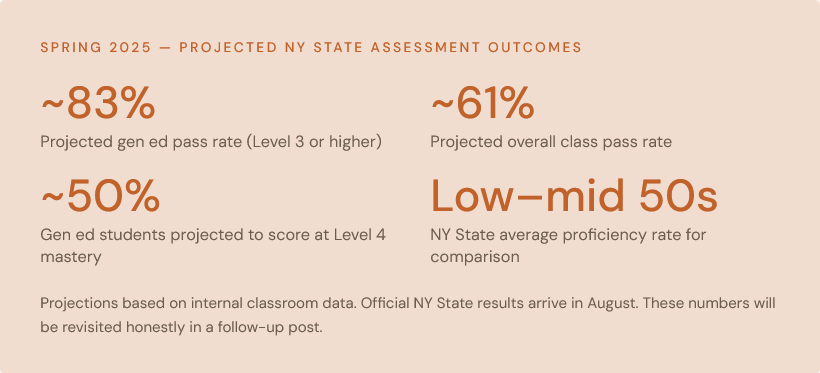
Let start with the overall number: a projected 61% pass rate across a class that is one-third IEP students. NY State proficiency averages in ELA and Math typically land in the low-to-mid 50s. On the surface, 61% might not sound dramatic — but in a classroom with this demographic composition, it sits meaningfully above state norms. Context matters enormously when reading proficiency data, and the context here is that a significant portion of this class was working against grade-level benchmarks that exceed their current IEP goals.
When you isolate the general education students, the projection sharpens considerably: roughly 83% passing, with approximately half of those students projected to earn a Level 4 — the mastery designation. That is not a class that was taught to the middle. That is a class where the highest-performing students were pushed upward while the most vulnerable students were simultaneously pulled toward the line.
The instructional choices we made — slowing down text work, protecting small group time, building fluency and vocabulary as non-negotiables — were not choices made for one kind of learner. They were choices that created more space for everyone. The Level 4 students got deeper, richer engagement with complex text because we weren’t racing through the curriculum. The struggling students got more targeted, consistent support because we protected the time for it. Both things happened in the same room, at the same time, because of the same structural decisions.
The Bubble Kids — What Their Story Really Tells Us
If I'm being honest, these are the kids this whole year was really about. Not my high fliers, not my already identified students, but the ones who fall somewhere in between and often are not given the attention they actually need. They are the students on the edges of the proficiency threshold.
Two of my general education students are heading into test week right at the line. I have been writing about both of them in my fluency intervention notes since January. They are my bubble kids — I identified them early, tracked them through the winter, and documented every adjustment we made together as the data shifted. These are not students who fell through the cracks. These are students I ran toward and worked to help get them as close to that proficiency line as possible.
If they cross the threshold and earn a Level 3, that result represents one of the most meaningful instructional wins of my year — because it will have come from four months of targeted, documented, relationship-based fluency work that no program assigned and no administrator required. It will have come from paying attention. If they get there it pushes my gen ed student pass rate to 100%, and that is not a number seen often in the education world.
If they don’t cross it — if the August score report places them just below — that result does not tell the story of students who were failed. It tells the story of students who grew significantly, whose gaps narrowed, and whose teacher already knows exactly what to build on next year. The score will be one data point. The intervention notes will be the real record.
Among my IEP students, I have two who are projected to reach proficiency — a Level 3 on a grade-level state assessment. I strongly feel one can reach it, and two others that are similar bubble students, alongside my two gen ed students. I want to say plainly how significant that is. These students are working within the parameters of IEPs that define their present levels, their goals, their services. The state assessment does not adjust for any of that. It measures them against the same grade-level standard as every other student in New York. For two of my IEP students to potentially clear that bar is not a small data point — it is a testament to a year of layered, intentional support that went beyond what any document required.
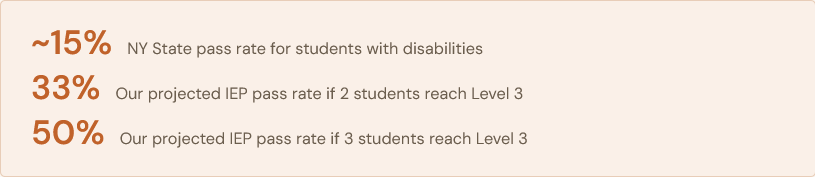
For the remaining IEP students, including two who arrived in December and March with weeks or months of instruction rather than a full year — their outcomes will need to be read with that context attached. A student who joined this classroom in March and sits for the April assessment has had approximately four weeks of instruction with this team. Whatever they produce on that test is almost entirely a reflection of where they came from, not where we were able to take them. That is not an excuse. It is an honest accounting of what is measurable and what is not.
What I Want You to Take From This
I’m not writing this to suggest that my co-teacher and I have figured something out that no one else has. I’m writing it because I spent a lot of this year feeling confident, but uncertain — wondering if the tension was worth it, wondering if the changes I was making were going to matter, wondering if the research I was following would show up in the outcomes.
The internal data says it is. My middle of the year benchmarks showed strong growth across the class. The ORF growth is there as well, all signaling strong performance on the NY state assessments. We’ll know more in August.
Here’s what I’d tell another teacher in the same spot: you can build this too. You don’t need a district initiative. You don’t need a new curriculum adoption or a professional development series or administrative buy-in before you start. You need data, you need evidence- based practices, you need to apply research to classroom practice, and you need at least one other person willing to commit to the kids with you.
Start with who is struggling. Ask what the evidence says about how to help them. Build the smallest possible consistent structure that gets you closer to that answer, and keep it consistent. Let your groups be fluid. Share a book. Have the Tuesday afternoon conversations. Document everything. And then keep going — even when it’s uncomfortable, even when the results are unclear, even when the path forward isn’t fully sanctioned.
None of what we have built was in place on the first day of school. All of it grew from paying attention. That’s available to every teacher in every building. The students in front of you cannot wait for perfect conditions. Neither can you.
If you’re a teacher who is doing this work quietly, in a room where no one’s watching — Keep going. It’s worth it.
I have learned a lot from reading about your walk to read model and your reflection on it as well. I look forward to hearing how your year ends as well!
This really resonates, thank you; particularly the idea of experienced teachers watching initiatives, trends and ‘fads’ coming and going, bringing many a new educational phase.
It seems like a powerful example of how much of the real work happens beneath the level of formal reform. I’ve been very interested in this idea lately. I explored something similar recently around the idea of ‘bolt-ons’ and how initiatives are often absorbed into practice rather than transforming it. I think this would resonate very well with your piece here.
I’d be really interested to hear your thoughts on it. Do you see what you built as working alongside the system, or in some ways in spite of it?
Hope you don’t mind me attaching a link here: https://samuelkammin.substack.com/p/supplementation-or-tokenism-bolt